Posters
Toward Virtual Animal Therapy: Evaluating Stress Reduction in VR-based User Interaction with a Virtual Dog
🎖️ Best Paper AwardHarassment Isn't Virtual When It Feels Real: Understanding Emotional Impact of Gendered Embodiment in VR.
Towards Gaze-Informed AI Disclosure Interfaces: Eye-Tracking Attentional and Cognitive Load While Reading AI-Assisted News
Full Disclosure, Less Trust? How the Level of Detail about AI Use in News Writing Affects Readers' Trust
Label Effects: Shared Heuristic Reliance in Trust Assessment by Humans and LLM-as-a-Judge
When Trust Meets Truth: Trust-Truth Separability in LLM-as-Judge
Vibe Coding in Product Teams: Reconfiguring AI-Assisted Workflows, Prototyping, and Collaboration
🎖️ Best Paper Honorable MentionEyes Can’t Always Tell: Fusing Eye Tracking and User Priors for User Modeling under AI Advice Conditions
Mapping the landscape of AI in Design and Creative Education
Understanding trust toward human versus AI-generated health information through behavioral and physiological sensing
The Impact of Immersive Journalism Technologies on Skip-Intention Behavior
Multi-sensory Dark Patterns
Disability, Differences, and Diversity: Revisiting Inclusive Design and Access
PhysioCHI: Lessons Learned from Implementing Human-Centered Physiological Computing
RCQoEA-360VR: Real-time Continuous QoE Scores for HMD-based 360° VR Dataset
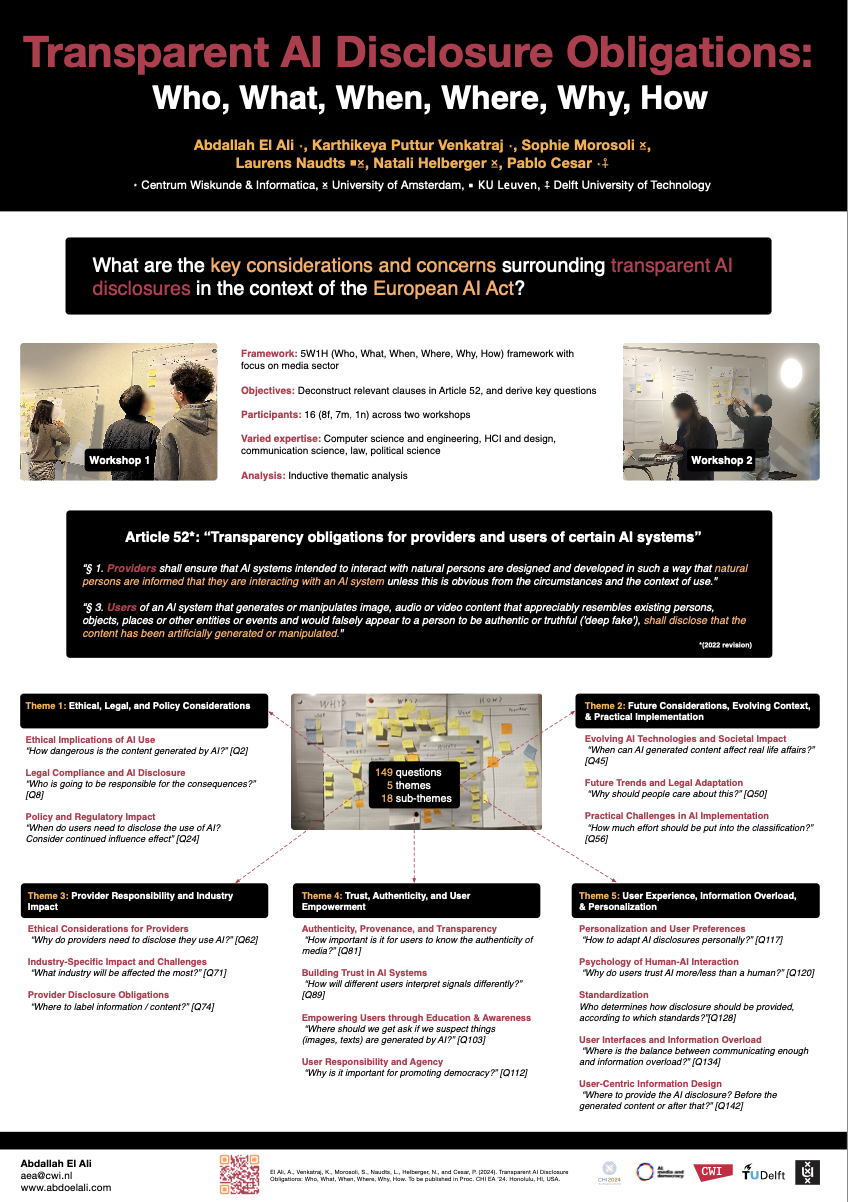
Understanding AI Disclosure Needs for News Production and Journalism
Script-Strategy Aligned Generation: Aligning LLMs with Expert-Crafted Dialogue Scripts and Therapeutic Strategies for Psychotherapy
Demonstrating Dark Haptics Scenarios for Future XR Advertising
The Future of Work is Blended, Not Hybrid
Rethinking the Alignment of Psychotherapy Dialogue Generation with Motivational Interviewing Strategies
Physiological Responses to Affective Virtual Coach Design in a VR Fear of Heights Consultation
Dark Haptics: Exploring Manipulative Haptic Design in Mobile User Interfaces
Haptic Biosignals Affect Proxemics Toward Virtual Reality Agents
Affective User Interfaces
MobiTouch: Enhancing Pneumatic Wearable Haptics with Vibrotactile Actuation
User Experience Design Professionals’ Perceptions of Generative Artificial Intelligence
ShareYourReality: Investigating Haptic Feedback and Agency in Virtual Avatar Co-embodiment
CHI NL at CHI 2024
Affective Driver-Pedestrian Interaction: Exploring Driver Affective Responses Toward Pedestrian Crossing Actions Using Camera and Physiological Sensors
Overview of the Netherlands AI, Media and Democracy Lab
Rethinking Hybrid Events in the Future of Work: A Hybrid Workshop for Creating a Better Hybrid World
From Video to Hybrid Simulator: Exploring Affective Responses toward Non-Verbal Pedestrian Crossing Actions using Camera and Physiological Sensors
The future of hybrid work is blended and interpersonal
Human Bodies as Interaction Materials for Somatic, Social, and Multisensory Virtual Reality Experiences
Designing for Affective Augmentation: Assistive, Harmful, or Unfamiliar?
CHI NL at CHI 2023
MEEC: Third Workshop on Momentary Emotion Elicitation and Capture
Designing Real-time, Continuous QoE Score Acquisition Techniques for HMD-based 360° VR Video Watching
Ethical Self-Disclosing Voice User Interfaces for Delivery of News
Towards SocialVR: Evaluating a Novel Technology for Watching Videos Together
Ethical Self-Disclosing Voice User Interfaces for Delivery of News
Social Virtual Reality Avatar Biosignal Animations as Availability Status Indicators
HCI Perspectives on Emerging Emotion Self-report Acquisition Techniques
SensiBlend: Sensing Blended Experiences in Professional and Social Contexts
CorrNet: Fine-Grained Emotion Recognition for Video Watching Using Wearable Physiological Sensors
Annotation Tool for Precise Emotion Ground Truth Label Acquisition While Watching 360-degree VR Videos
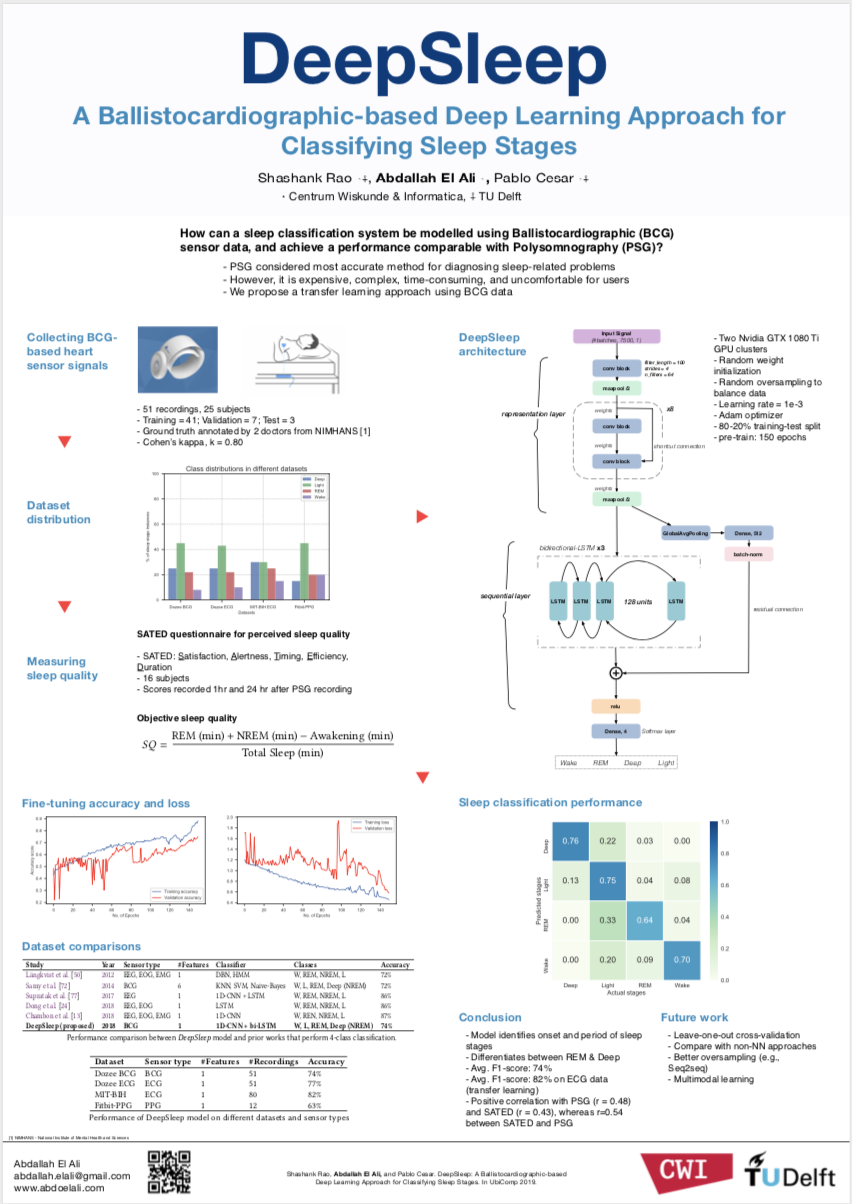
DeepSleep: A Ballistocardiographic Deep Learning Approach for Classifying Sleep Stages
Measuring and Understanding Photo Sharing Experiences in Social Virtual Reality
Machine Learning for Intelligent User Interfaces Using Keras
Digitale, automatisierte Analyse von Literaturdatenbanken in Public Health und Pflegewissenschaft – Quantitative Textanalyse großer Ergebnismengen mittels Topic Modeling
Badum Tss! - A Paper-based Interaction to Augment Everyday Situations with Sound Effects
Peripheral Light Cues for In-Vehicle Task Resumption
Minimal Mobile Human Computer Interaction
Multimodal Interaction Design in Collocated Mobile Phone Use
Studying and Designing for Mobile Social Awareness Cues in Urban Interactions
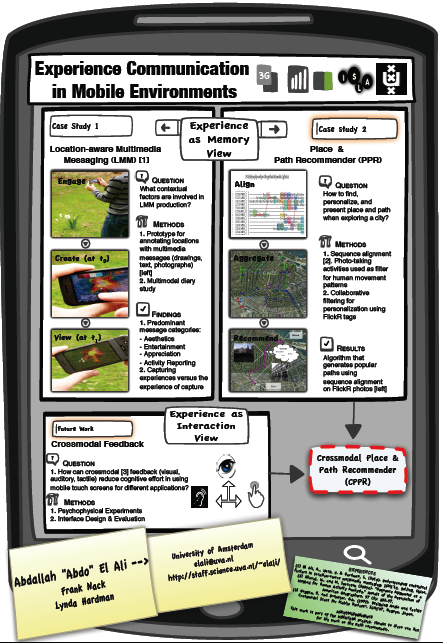
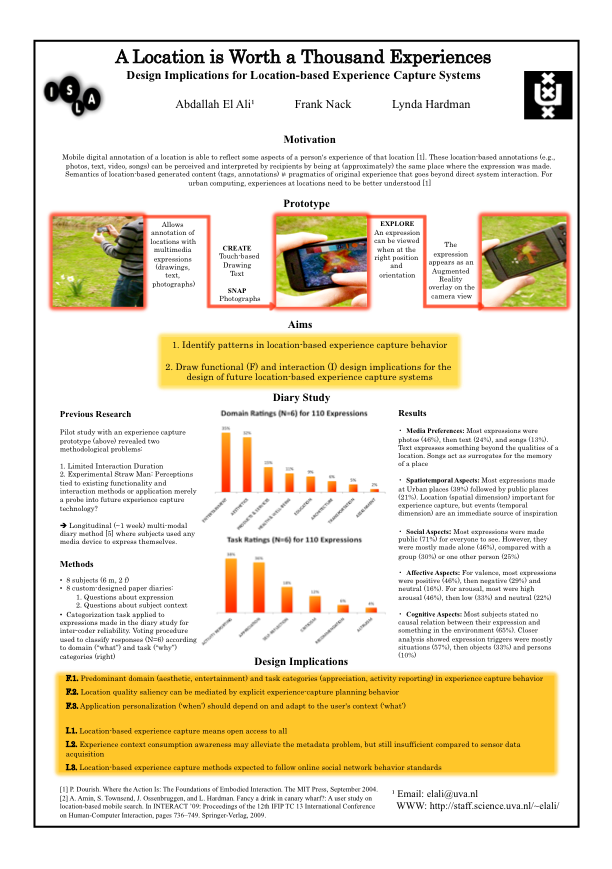
Good Times?! Playful Aspects of Location-based Experience Capture
Touring in a Living Lab: some methodological considerations
Judging Amy: Automated legal assessment using OWL 2
Reproducing the Passage of Time: Effects of Stimulus Complexity, Quantity, and Cognitive Interference
Developing HARNESS
Comparing models of EU directive 90/434/eec
Modeling Nomic in LKIF-core ontology